
The automotive landscape of 2026 represents a historic turning point. Electric vehicles (EVs) have officially transitioned from a niche luxury to the primary choice for the global mainstream. With a market share now exceeding 26 percent, the conversation has shifted from “should I buy one” to “how much will it cost to keep it on the road.”
- The Myth of Maintenance-Free Driving
- Battery Health and Thermal Management: The Core of 2026 Service
- Tire Economics: The High-Torque Penalty
- Software-Defined Maintenance: The Subscription Frontier
- Braking and Suspension: A Tale of Two Systems
- Advanced Driver Assistance Systems (ADAS) and Sensor Calibration
- Insurance and Repair: The Hidden 2026 Premium
- Brand-Specific Maintenance Costs in 2026
- Comparative Analysis: EV vs. ICE in 2026
- Financial Strategies for Lowering EV Maintenance Costs
- Regional Variations in 2026
- Future Outlook: Beyond 2026
- Conclusion
While the early marketing for electric cars promised a future of zero maintenance, the reality in 2026 is more nuanced. While you no longer deal with oil changes, spark plugs, or timing belts, a new category of maintenance has emerged. From advanced battery diagnostics to high-torque tire wear and software-defined service fees, staying ahead of these costs is essential for every modern driver.
The Myth of Maintenance-Free Driving
It is a common misconception that electric vehicles require no upkeep. While it is true that an EV powertrain contains roughly 20 moving parts compared to the 2,000 plus components in an internal combustion engine (ICE), the parts that remain are often more sophisticated and subject to different types of stress.
In 2026, maintenance is less about mechanical repair and more about system optimization. Owners are finding that while they visit the shop less frequently, the complexity of those visits has increased. The focus is now on the “Digital Chassis” and the high-voltage systems that power it.
Battery Health and Thermal Management: The Core of 2026 Service
The battery remains the most expensive component of any electric vehicle. By 2026, battery pack prices have stabilized at approximately $80 per kilowatt-hour, a significant drop from early 2020 levels. However, protecting this investment is the top priority for maintenance schedules.
Battery Diagnostic Health Checks
Standard maintenance in 2026 now includes a deep-tier battery diagnostic. Dealers and independent certified shops use specialized software to measure cell balance and state of health (SoH). These checks are vital for maintaining resale value. A vehicle with a certified 95 percent SoH can command a premium of $3,000 to $5,000 over a similar model with unknown battery health.
Thermal Management Fluid Exchange
Modern EV batteries rely on complex liquid cooling and heating systems to maintain optimal temperatures. In 2026, manufacturers like Tesla, Hyundai, and Ford recommend a coolant flush and system pressure test every five to seven years. This service ensures that the battery does not overheat during ultra-fast charging or degrade prematurely in extreme climates. Neglecting this can lead to a 15 percent faster degradation rate over the life of the vehicle.
Tire Economics: The High-Torque Penalty
If there is one area where EV owners spend more than ICE owners, it is on rubber. The combination of instant torque and the significant weight of battery packs (often 15 to 25 percent heavier than gas cars) puts immense pressure on tires.
Accelerated Wear Rates
Data from late 2025 and early 2026 suggests that EV tires wear out roughly 20 percent faster than those on traditional cars. For a mainstream crossover like the Mustang Mach-E or the Ioniq 5, a set of tires typically lasts between 30,000 and 40,000 miles. For high-performance models or heavy electric trucks like the Rivian R1T, this interval can drop to 20,000 miles.
Cost of Specialized EV Rubber
EV-specific tires are designed with lower rolling resistance to maximize range and foam inserts to reduce cabin noise. In 2026, a set of four high-quality EV tires costs between $800 and $1,100 for a standard sedan. Large SUV or truck tires can easily exceed $1,500 per set. Regular rotations every 6,000 miles are no longer optional: they are a financial necessity to avoid uneven wear caused by the heavy load on the front axles.
Software-Defined Maintenance: The Subscription Frontier
The most significant change in 2026 is the rise of software as a service (SaaS) within the vehicle. Many manufacturers have moved toward a model where certain features and performance optimizations are unlocked via monthly or annual fees.
Connectivity and Navigation
Tesla’s Premium Connectivity remains a staple at $9.99 per month, but other brands have followed suit. Mercedes-Benz and Audi now offer tiered “Experience Packages” that include advanced satellite navigation and live traffic data for roughly $200 per year.
Performance and Safety Subscriptions
In 2026, it is common to see “Pay-to-Play” hardware features. BMW has expanded its model where features like heated steering wheels or adaptive cruise control are available for a monthly fee (approximately $15 to $40 depending on the feature). While this is technically not “repair,” it is a recurring ownership cost that must be factored into the annual budget.
Over-The-Air (OTA) Update Management
While many OTA updates are free, some “Feature Drops” in 2026 are paid. These might include improved battery management algorithms that add 10 miles of range or enhanced autopilot capabilities. Owners should set aside a small “software fund” to keep their vehicle’s intelligence current.
Braking and Suspension: A Tale of Two Systems
EVs utilize regenerative braking, which uses the electric motor to slow the vehicle while recharging the battery. This system drastically reduces wear on traditional brake pads and rotors.
Brake Longevity
It is not uncommon for EV brake pads to last 100,000 miles or more. In 2026, the primary maintenance cost for brakes is not replacement, but lubrication. Because the physical brakes are used so infrequently, they can sometimes seize or develop surface rust in humid or salty environments. A “Brake Service” in 2026 usually involves cleaning and greasing the calipers rather than swapping the pads.
Suspension Stress
The trade-off for saved brakes is increased suspension wear. Carrying a 1,000 pound battery pack means that bushings, struts, and ball joints are under constant stress. In 2026, suspension inspections are a critical part of the 50,000 mile service interval. Replacing worn suspension components on a heavy EV can be 20 percent more expensive than on a lighter gasoline car due to the need for reinforced parts.
Advanced Driver Assistance Systems (ADAS) and Sensor Calibration
By 2026, almost every new EV is equipped with a suite of Lidar, Radar, and high-definition cameras. These systems are essential for the semi-autonomous features that define modern driving.
The Cost of a Cracked Windshield
In the past, a rock chip in a windshield was a minor $200 repair. In 2026, because cameras are mounted behind the glass, a windshield replacement on a Tesla Model Y or a Lucid Air can cost upwards of $1,500. This includes the cost of the specialized glass and the labor for “Static and Dynamic Calibration” of the ADAS sensors.
Fender Benders and Sensor Realignment
Minor collisions that used to involve simple bodywork now require high-tech intervention. If a bumper containing ultrasonic sensors is bumped, the system must be recalibrated to ensure safety features like Emergency Braking function correctly. This adds a “Digital Surcharge” to almost every collision repair in 2026.
Insurance and Repair: The Hidden 2026 Premium
Insurance premiums for electric vehicles in 2026 remain roughly 5 percent to 10 percent higher than for equivalent ICE vehicles. This is driven by three main factors.
First, the complexity of repairs means that fewer independent shops are certified to work on EVs, keeping labor rates high. Second, the cost of parts: specifically the battery and specialized sensors: remains elevated. Third, the “Total Loss” threshold is lower. If a battery pack is even slightly dented in an accident, insurance companies in 2026 often choose to write off the entire vehicle rather than risk the liability of a repaired high-voltage battery.
Brand-Specific Maintenance Costs in 2026
To provide a clear picture of the market, here is a breakdown of what owners are paying for mainstream models in 2026.
Tesla (Model 3 and Model Y)
- Annual Cabin Air Filter (HEPA): $60 to $100.
- Brake Caliper Service (every 2 years): $150.
- Tire Replacement (set of 4): $900.
- Tesla remains one of the most affordable to maintain due to its vertical integration and simplified service menus.
Ford F-150 Lightning
- Annual Multi-Point Inspection: $150.
- Coolant System Check: $200.
- Heavy-Duty Tire Replacement: $1,200 to $1,600.
- The Lightning’s weight makes tire and suspension checks the primary cost driver.
Mercedes-Benz EQS
- Service A (Minor): $350.
- Service B (Major): $650.
- Battery Health Certification: $250.
- Luxury EVs continue to follow the traditional dealership service model with higher labor rates.
Rivian (R1S and R1T)
- Comprehensive Check-up: $300.
- Off-road suspension alignment: $250.
- Rivian’s “Mobile Service” is highly popular in 2026, often allowing maintenance to be performed in the owner’s driveway for a convenience fee.
Comparative Analysis: EV vs. ICE in 2026
When we look at the total cost of ownership (TCO) over a five-year period in 2026, the EV remains the clear financial winner for most drivers.
Maintenance and Repair Totals
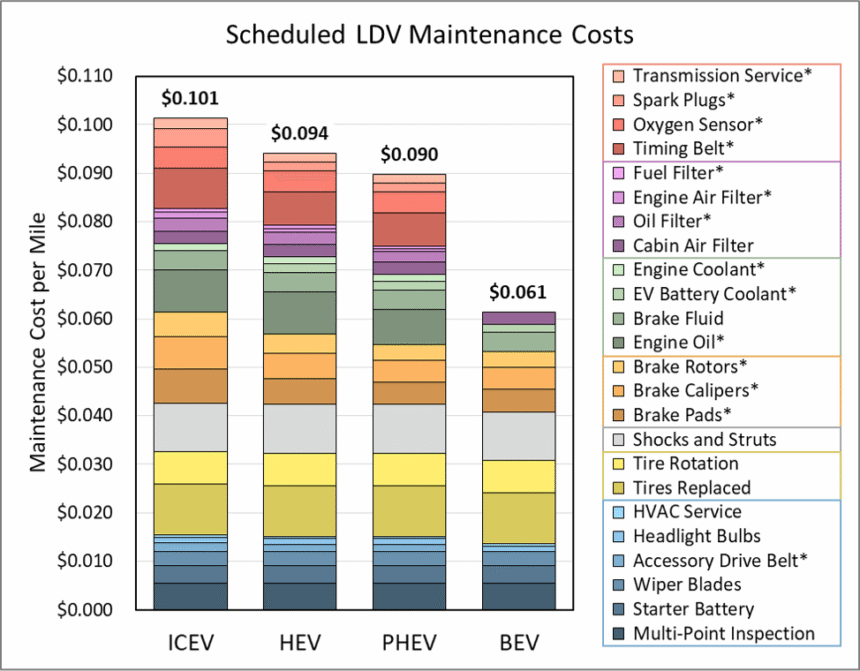
- Average ICE Vehicle (5 Years): $4,500 to $6,000 (Oil, brakes, belts, transmission service, spark plugs).
- Average EV Vehicle (5 Years): $2,500 to $3,500 (Tires, cabin filters, software fees, coolant checks).
The Fuel vs. Energy Gap
In 2026, the cost of electricity averages roughly 15 cents per kWh in the United States, while gasoline fluctuates between $3.50 and $4.50 per gallon. For a driver doing 12,000 miles per year, the energy savings alone (approx. $1,200 annually) more than offset the higher cost of EV tires and insurance.
Financial Strategies for Lowering EV Maintenance Costs
Drivers in 2026 have found several ways to keep their upkeep costs at a minimum.
Telematics-Based Insurance
Many owners now use manufacturer-provided insurance (like Tesla Insurance) or third-party telematics. By allowing the insurer to monitor driving habits (speed, braking force, and time of day), safe drivers can save up to 30 percent on their monthly premiums.
Independent Certified Shops
The “Right to Repair” movement has gained significant ground by 2026. Many independent mechanics are now certified in high-voltage systems. Using a reputable local shop instead of a dealership for non-warranty items like tires, alignments, and suspension work can save owners 20 percent on labor costs.
Proactive Battery Care
Using the 20 to 80 percent charging rule remains the best way to avoid the catastrophic cost of battery replacement. Owners who minimize “Deep Cycles” and avoid frequent 350kW ultra-fast charging are seeing their batteries last well beyond 200,000 miles with less than 10 percent degradation.
Regional Variations in 2026
Maintenance costs are not uniform. In Europe, new 2026 laws regarding vehicle weight have led to “Weight Penalties” on registration for heavy EVs, adding an indirect ownership cost. In China, the massive scale of the EV market has driven maintenance costs down significantly, with battery swapping stations (like those from NIO) making battery maintenance a problem of the past for many urban dwellers.
Future Outlook: Beyond 2026
As we look toward 2027 and 2028, the next major shift in maintenance will be the arrival of solid-state batteries. These units promise even less degradation and lower thermal management needs, potentially cutting maintenance costs by another 15 percent. Furthermore, AI-driven predictive maintenance will become standard, where your car will diagnose a failing component and schedule its own repair appointment before a breakdown even occurs.
Conclusion
Electric car maintenance in 2026 is a study in trade-offs. You trade the dirty, frequent mechanical repairs of the past for cleaner, more predictable, but higher-tech upkeep. While tires and insurance remain expensive, the overall reduction in moving parts and the massive savings in energy costs make EVs the most economically sound choice for the modern era.
By staying informed about battery health, managing software subscriptions wisely, and staying proactive with tire care, you can ensure that your electric vehicle remains a high-performing, cost-effective asset for years to come.