
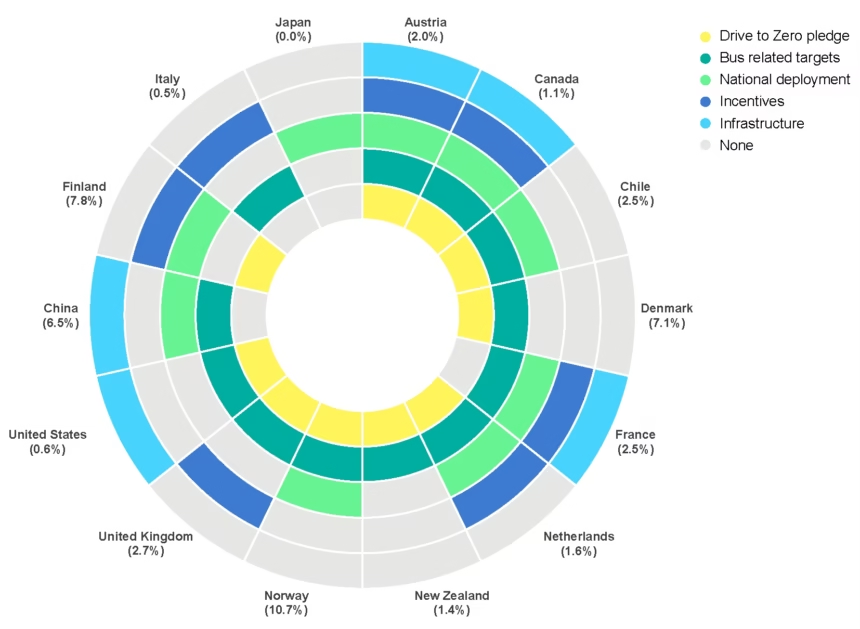
The year 2026 marks a defining moment in the history of global transportation. As nations race toward ambitious net zero targets, the landscape of electric vehicle mobility has transitioned from a niche market into the primary focus of the automotive industry. For consumers, this shift is characterized by a complex yet rewarding network of financial support systems designed to make the transition to zero emission travel more affordable than ever before.
- United States: The Evolution of the Clean Vehicle Credit
- France: A Model for Socially Conscious Mobility
- Germany: The Relaunch of National Subsidies
- Norway: Managing the Success of Total Electrification
- United Kingdom: Focused on the Corporate Fleet
- China: Transitioning Toward High Quality Growth
- Canada: A Provincial Patchwork
- Australia: Fringe Benefits and Luxury Tax Savings
- Emerging Trends in 2026: Infrastructure and Technology
- Strategic Buying Tips for 2026
- Conclusion: The Road Ahead
Governments across the globe have updated their policy frameworks for 2026, moving away from broad subsidies and toward more targeted, strategically aligned programs. These initiatives prioritize low income accessibility, domestic manufacturing, and the development of robust charging networks. In this comprehensive guide, we explore the latest electric vehicle incentives by country, providing you with the data needed to maximize your savings while contributing to a cleaner future.
United States: The Evolution of the Clean Vehicle Credit
In the United States, the federal approach to sustainable mobility remains centered on the Inflation Reduction Act. However, the requirements for 2026 have become significantly more stringent to encourage domestic supply chain security.
Federal Tax Credit Requirements for 2026
The Clean Vehicle Credit, governed by Internal Revenue Code Section 30D, continues to offer a maximum potential credit of $7,500 for eligible new vehicles. In 2026, the criteria for this credit are divided into two distinct components:
- Critical Minerals Requirement: To qualify for $3,750 of the credit, at least 70% of the value of critical minerals contained in the vehicle’s battery must be extracted or processed in the United States or a country with which the U.S. has a free trade agreement. This is a 10% increase from the 2025 threshold.
- Battery Component Requirement: For the remaining $3,750, at least 70% of the value of the battery components must be manufactured or assembled in North America.
Vehicles that meet both criteria receive the full $7,500 benefit. It is also important to note that the price caps remain in place: $80,000 for vans, sport utility vehicles, and pickup trucks, and $55,000 for other passenger cars.
New Incentives for Infrastructure and Loans
Beyond the purchase price, 2026 brings expanded support for charging and financing. The Alternative Fuel Vehicle Refueling Property Tax Credit is available for equipment installed before June 30, 2026. For residential installations, this credit covers 30% of the cost, up to $1,000. For businesses, the credit can reach as high as $100,000 per location in eligible census tracts.
Furthermore, some manufacturers and lenders are now offering interest rate deductions. In certain programs, individuals can receive up to a $10,000 deduction on loan interest for new passenger vehicles under 14,000 pounds, provided final assembly was completed in the U.S. and the vehicle is for personal use.
State-Level Highlights
California continues to lead with its Clean Cars 4 All program, which offers up to $7,500 for low income residents to scrap older vehicles and purchase cleaner alternatives. New York and New Jersey have also maintained their point of purchase rebates, often ranging from $2,000 to $4,000, which can be stacked with federal benefits.
France: A Model for Socially Conscious Mobility
France has emerged as a leader in European policy by implementing a system that rewards both environmental efficiency and social equity. The 2026 framework is built upon the successful Ecological Bonus and the innovative Social Leasing program.
The Ecological Bonus and Ecoscore System
The French government has confirmed the extension of its purchase bonus scheme through 2026. The amounts are tiered based on household income:
- Modest Households: Eligible for a bonus of up to €4,200.
- Standard Households: Eligible for a bonus of up to €3,100.
- European Bonus: An additional €1,000 is available for vehicles equipped with batteries manufactured within the European Union.
Crucially, France uses an “environmental score” to determine eligibility. This score accounts for the carbon footprint of the entire manufacturing process, including the energy mix of the country of origin and the logistics of transport. This means that vehicles produced in regions with high carbon energy grids may not qualify, regardless of their tailpipe emissions.
Weight Penalties and Mass Limits
Starting January 1, 2026, France is tightening its weight penalty (malus au poids). The threshold for this penalty is now 1,500 kilograms, down from 1,600 kilograms. While most electric vehicles are given an allowance of 600 kilograms to account for battery weight, only “ecoscored” electric models will remain totally exempt from July 1, 2026, onwards. Vehicles exceeding 2,100 kilograms that do not meet these criteria will face progressive taxation, ranging from €10 to €30 per additional kilogram.
Germany: The Relaunch of National Subsidies
After a period of reduced support, Germany has moved to revitalize its automotive sector with a significant new incentive package for 2026.
The €3 Billion Transition Fund
The German government has allocated €3 billion to be distributed between 2026 and 2029. This new program focuses on making sustainable mobility accessible to low and middle income earners.
- Purchase Bonus: Buyers can receive up to €4,000 for a new battery electric vehicle.
- Price Cap: To ensure the funds support affordable models, the net list price of the vehicle must be under €45,000.
- Used Vehicle Inclusion: For the first time, used electric cars are eligible for subsidies, recognizing that the secondary market is vital for widespread adoption.
This policy shift reflects Germany’s commitment to supporting its domestic manufacturers as they scale up production of compact and mid sized electric models. By targeting the €45,000 price point, the government is incentivizing brands to offer more competitive pricing for the mass market.
Norway: Managing the Success of Total Electrification
Norway remains the global benchmark for electric vehicle adoption, with zero emission models capturing nearly 95% of the new car market. As a result, 2026 represents a phase where incentives are being gradually rebalanced.
VAT Threshold Adjustments
The famous VAT exemption that fueled Norway’s revolution is being modified to ensure fiscal sustainability. In 2026, the threshold for VAT exemption on electric cars will decrease from 500,000 NOK to 300,000 NOK. Buyers will pay a 25% VAT on the portion of the price exceeding this 300,000 NOK limit.
Even with this change, electric cars remain significantly more attractive than internal combustion models. The one off registration tax for fossil fuel vehicles is set to increase by another 20,000 to 30,000 NOK in 2026, maintaining a wide price gap in favor of sustainable options.
United Kingdom: Focused on the Corporate Fleet
The United Kingdom has shifted its primary focus from direct purchase grants to tax incentives for company cars and salary sacrifice schemes.
Benefit in Kind (BiK) Rates
For the 2026 to 2027 tax year, the Benefit in Kind rate for zero emission vehicles will rise to 4%, up from 3% in the previous year. While this is a slight increase, it remains remarkably low compared to the 37% rate applied to the most polluting vehicles.
The UK’s Zero Emission Vehicle (ZEV) mandate also places a legal requirement on manufacturers to ensure that at least 33% of their new car sales in 2026 are zero emission. This regulatory pressure is expected to lead to aggressive pricing and attractive financing deals as manufacturers strive to meet their targets.
China: Transitioning Toward High Quality Growth
As the world’s largest market for new energy vehicles (NEVs), China is moving from high volume growth to a focus on technological excellence.
Tax Reductions and Technical Thresholds
Starting January 1, 2026, the purchase tax policy for NEVs will shift from full exemption to a 50% reduction. The maximum tax reduction will be capped at RMB 15,000 per vehicle.
Furthermore, China has introduced stricter technical requirements:
- Energy Consumption: Pure electric vehicles must meet higher efficiency standards regarding power consumption per 100 kilometers.
- PHEV Range: Plug in hybrids must now offer a minimum pure electric range of 100 kilometers, up from 43 kilometers, to qualify for any tax benefits.
These changes are designed to push manufacturers toward better battery technology and more efficient vehicle designs.
Canada: A Provincial Patchwork
While the federal iZEV program in Canada has faced funding pauses due to overwhelming demand, provincial incentives remain robust in 2026.
Regional Rebates
- Quebec: The Roulez Vert program provides up to $4,000 for vehicles with an MSRP under $60,000.
- British Columbia: CleanBC offers income based rebates up to $4,000.
- Prince Edward Island: Offers some of the most generous support in the country, with rebates reaching $5,000 plus an additional $1,000 for vehicle scrappage.
Canada’s ZEV mandate for 2026 requires that 20% of all new light duty vehicle sales be zero emission, ensuring that a wide variety of models will be available to consumers across the provinces.
Australia: Fringe Benefits and Luxury Tax Savings
Australia has seen a rapid increase in electric vehicle market share, supported by federal tax exemptions that remain in effect through 2026.
FBT Exemption and Luxury Car Tax
The Fringe Benefits Tax (FBT) exemption for eligible electric vehicles remains a major draw for employees using salary packaging. For the 2025 to 2026 financial year, the threshold for this exemption is set at $91,387.
Additionally, the Luxury Car Tax (LCT) threshold for fuel efficient vehicles is significantly higher than for standard vehicles, providing a saving of over $3,000 for premium electric models compared to their petrol counterparts. A statutory review of these policies is currently underway, but the settings for the current fiscal year provide certainty for buyers.
Emerging Trends in 2026: Infrastructure and Technology
The incentives of 2026 are not limited to the vehicles themselves. There is a growing emphasis on “Vehicle to Everything” (V2X) technology and the circular economy for batteries.
Charging Infrastructure Grants
Many countries, including Italy and Spain, have introduced 2026 grants specifically for smart charging stations. These grants often cover up to 80% of installation costs for private individuals who install chargers capable of bidirectional charging. This allows the vehicle to act as a battery for the home, providing energy during peak hours or during power outages.
Battery Recycling Incentives
New regulations in the European Union and China are incentivizing the use of recycled materials in battery production. In 2026, manufacturers that can prove a high percentage of recycled lithium, cobalt, and nickel in their cells may be eligible for production credits, which in turn helps lower the retail price for consumers.
Strategic Buying Tips for 2026
To get the most value out of the 2026 incentive landscape, consider the following strategies:
- Check the Origin: In markets like the U.S. and France, where the vehicle is built and where the battery materials come from is as important as the price. Always verify the “Ecoscore” or “IRA compliance” of a model before purchasing.
- Monitor the MSRP: Many incentives have strict price ceilings (e.g., €45,000 in Germany or $55,000 in the U.S.). Selecting a lower trim level or avoiding certain options can sometimes save you thousands in lost tax credits.
- Understand the Delivery Date: In many jurisdictions, the incentive is tied to the date of first registration, not the date of the order. If you order a car in late 2025 for a 2026 delivery, ensure you understand which policy will apply.
- Leverage Fleet Discounts: If you are a business owner or have access to a company car scheme, the tax savings in 2026 are often significantly higher than those available for private cash purchases.
Conclusion: The Road Ahead
The electric vehicle incentives of 2026 represent a sophisticated effort by global governments to balance economic priorities with environmental necessity. While some of the massive, unrestricted grants of the early 2020s have been replaced by more nuanced systems, the total cost of ownership for electric vehicles has never been more competitive.
By understanding the specific rebates, tax credits, and exemptions available in your region, you can make an informed decision that benefits both your finances and the planet. The transition to sustainable mobility is no longer a future goal: it is the reality of 2026.
Sources and Further Reading
For live, daily updates on specific policy changes and local program availability, please consult the following official resources:
- United States: Alternative Fuels Data Center (Department of Energy)
- European Union: European Alternative Fuels Observatory (EAFO)
- France: Je Change ma Voiture (Official Government Portal)
- Germany: Federal Office for Economic Affairs and Export Control (BAFA)
- Norway: Norwegian Electric Car Association (Norsk Elbilforening)
- United Kingdom: Office for Zero Emission Vehicles (OZEV)
- Canada: Transport Canada iZEV Program
- Australia: Green Vehicle Guide (Australian Government)