
The automotive landscape is undergoing a massive transformation as we approach a defining year for electric mobility. For enthusiasts, investors, and daily commuters alike, 2026 represents a historic pivot point. Manufacturers are no longer just experimenting with battery power; they are launching flagship models that redefine performance, luxury, and utility. This guide provides a comprehensive look at the most significant electric vehicle (EV) releases scheduled for 2026, detailing everything from technical specifications to market impact.
- The Luxury Segment: A New Era of Sophistication
- The High Tech Innovators: AI and Software Defined Vehicles
- Mass Market Expansion: Affordability and Accessibility
- Rugged Utility: The Return of the Scout
- Technical Deep Dive: What is Powering the 2026 Lineup?
- Market Trends: Insurance, Financing, and Investment
- Conclusion: Preparing for the Electric Future
The Luxury Segment: A New Era of Sophistication
The premium market is seeing an influx of models that combine traditional craftsmanship with cutting-edge software. Leading the charge are established icons and ambitious newcomers ready to challenge the status quo.
Porsche Cayenne Electric: The Standard of Performance SUVs
Porsche has confirmed that its best selling SUV will transition to an all electric platform for the 2026 model year. Built on the Premium Platform Electric (PPE) architecture, the Cayenne Electric is designed to offer the same visceral driving dynamics as its internal combustion predecessors.
Expected variants include a base model and a high performance Turbo variant. Early data suggests the Turbo model could produce over 1,000 horsepower when utilizing its launch control and overboost functions. With a 113 kWh battery pack and 800 volt architecture, the Cayenne Electric will support 400 kW DC fast charging. This means drivers can replenish the battery from 10 percent to 80 percent in approximately 16 minutes.
The interior will be a masterpiece of digital integration. A curved 14.25 inch instrument cluster and an optional passenger display ensure that everyone in the cabin remains connected. Pricing is expected to start around $109,000 for the base model, while the Turbo variant will likely exceed $160,000.
Source: Edmunds 2026 Porsche Cayenne Electric First Look
Cadillac Vistiq: Three Rows of American Luxury
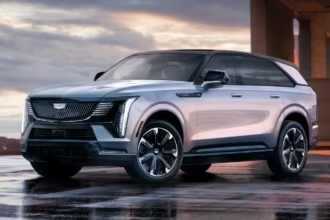
Cadillac is expanding its IQ sub brand with the Vistiq, a three row luxury SUV that fills the gap between the Lyriq and the massive Escalade IQ. The Vistiq is aimed squarely at families who refuse to compromise on style or space.
Standard features for the Vistiq include a dual motor all wheel drive system producing 615 horsepower and 650 lb ft of torque. Cadillac estimates a range of 300 miles on a full charge. One of the most impressive features is the 33 inch diagonal LED display that spans the dashboard, powered by Google Built-in. For those concerned with long distance travel, the Vistiq comes standard with Super Cruise, the industry leading hands-free driver assistance technology.
Pricing for the Vistiq starts at approximately $77,395, making it a competitive option in the luxury three row segment.
Source: Cadillac Official Vistiq Preview
The High Tech Innovators: AI and Software Defined Vehicles
In 2026, the car becomes more than a mode of transport; it becomes a mobile computing platform. Sony and Honda have teamed up to create a vehicle that prioritizes entertainment and connectivity as much as driving.
Sony Honda Mobility AFEELA: The Moving Entertainment Hub
The AFEELA 1 is perhaps the most anticipated “tech first” car of the decade. This mid-size liftback is a joint venture between Sony’s electronics expertise and Honda’s automotive engineering.
The production version features a dual motor all wheel drive layout producing 483 horsepower. It is equipped with a 91 kWh battery providing an estimated 300 miles of range. However, the real story is inside the cabin. The AFEELA features a panoramic screen that stretches from pillar to pillar, capable of running AAA games and immersive 3D maps via the Unreal Engine.
With over 40 sensors, including LiDAR and high resolution cameras, the AFEELA aims for Level 3 autonomous driving capabilities under specific conditions. Deliveries are expected to begin in mid-2026 with a starting price of roughly $102,900.
Source: AFEELA Official Specifications
Tesla Roadster: Breaking the Limits of Physics
While the second generation Tesla Roadster has seen its share of delays, the latest updates from Tesla suggest a 2026 launch for this halo supercar. Elon Musk has claimed that the Roadster will achieve a 0 to 60 mph time of less than one second when equipped with the optional SpaceX rocket thruster package.
Even without rocket assistance, the base specs are staggering: a 620 mile range from a 200 kWh battery and a top speed exceeding 250 mph. The Roadster will feature a removable glass roof and seating for four, though the rear seats are expected to be tight. Pricing is anticipated at $200,000 for the base model, with the Founders Series reaching $250,000.
Source: Car and Driver Tesla Roadster Overview
Mass Market Expansion: Affordability and Accessibility
For electric vehicles to achieve true dominance, they must become accessible to the average buyer. 2026 will see the launch of several models priced under $50,000, offering high range and modern features.
Rivian R2: The Adventure SUV for the Masses
The Rivian R2 is the vehicle that could take the brand to the next level. Smaller and more affordable than the R1S, the R2 retains the rugged, outdoorsy aesthetic that fans love.
Starting at an estimated $45,000, the R2 will offer three motor configurations: Single Motor RWD, Dual Motor AWD, and a Tri Motor AWD capable of 0 to 60 mph in under three seconds. Rivian expects the R2 to deliver over 300 miles of range. A unique feature of the R2 is its “adventure ready” interior, where all seats (including the driver’s) fold flat to accommodate camping gear or even an interior mattress.
Deliveries are slated to begin in the first half of 2026.
Source: Rivian R2 Official Site
BMW iX3: The Neue Klasse Revolution
BMW is launching its “Neue Klasse” (New Class) platform in 2026, starting with the all new iX3. This is not just an electric version of the X3; it is a ground-up redesign focused on efficiency and sustainability.
The new iX3 will feature Gen6 eDrive technology, which utilizes cylindrical battery cells that offer 20 percent higher energy density than previous designs. This allows for a range of up to 400 miles on a single charge. The iX3 50 xDrive variant is expected to produce 463 horsepower. Inside, the traditional instrument cluster is replaced by BMW Panoramic Vision, which projects vital information across the entire width of the lower windshield.
Production for the US market is set to begin in early 2026 with a starting price of approximately $60,000.
Source: TopElectricSUV BMW iX3 Report
Lucid Earth: Efficiency Meets Economy
Lucid Motors, known for the record breaking range of the Air sedan, is entering the mid-size SUV market with a model likely named the Lucid Earth. This vehicle is designed to compete directly with the Tesla Model Y.
The Lucid Earth is expected to start under $50,000 and utilize Lucid’s highly efficient “Atlas” motor technology. This efficiency should allow the Earth to achieve a 350 to 400 mile range with a smaller, lighter, and more cost effective battery pack than its competitors. Production is scheduled to start in late 2026.
Source: Lucid Motors Upcoming Models
Rugged Utility: The Return of the Scout
One of the most exciting stories of 2026 is the resurrection of the Scout brand. Backed by the Volkswagen Group, Scout Motors is building rugged, body-on-frame EVs designed for off-road enthusiasts.
Scout Traveler and Terra
The Scout Traveler (SUV) and Terra (Pickup Truck) are inspired by the original International Harvester Scout. Both vehicles feature mechanical lockers, a solid rear axle, and a front sway bar disconnect for serious trail work.
For those with range anxiety, Scout is offering an optional gas powered “Harvester” range extender, which can boost the total range to over 500 miles. The pure electric versions are targeted at 350 miles. Unique features include a front bench seat option and real tactile buttons and knobs, a rarity in the modern EV era. Prices are expected to start under $60,000 when factoring in available incentives.
Source: Scout Motors Traveler and Terra Preview
Technical Deep Dive: What is Powering the 2026 Lineup?
The vehicles arriving in 2026 are benefiting from significant breakthroughs in battery chemistry and charging infrastructure. Understanding these technical shifts is key to understanding why 2026 is such a milestone.
The Shift to NACS (North American Charging Standard)
Nearly every major manufacturer has announced a transition to the NACS port, the charging standard popularized by Tesla. For the 2026 models, this means most new cars will come with the NACS port built-in, allowing seamless access to the Tesla Supercharger network without the need for bulky adapters. This shift significantly reduces one of the primary barriers to EV adoption: reliable public charging.
800 Volt Architecture and Solid State Progress
High end models from Porsche, Audi, and Hyundai are increasingly adopting 800 volt electrical systems. This technology doubles the charging speed compared to the standard 400 volt systems used in many current EVs. While true solid state batteries are still in the pilot phase, several 2026 models will use semi-solid state components or highly refined lithium iron phosphate (LFP) chemistries to improve safety and longevity.
Software Defined Vehicles (SDV)
The concept of the “Software Defined Vehicle” matures in 2026. Models like the BMW iX3 and Cadillac Vistiq are designed so that nearly every aspect of the car can be updated over the air (OTA). This includes everything from suspension tuning and motor efficiency to infotainment features and autonomous driving algorithms. This ensures that the vehicle stays current and potentially increases in value over time as new features are added.
Market Trends: Insurance, Financing, and Investment
As the EV market matures, the financial landscape surrounding these vehicles is also shifting. Buyers in 2026 should be aware of several trends that affect the total cost of ownership.
Insurance Premiums for High Performance EVs
Insuring luxury EVs like the Porsche Cayenne Electric or the Tesla Roadster can be more expensive than insuring their gas counterparts. This is due to the high cost of specialized components, such as large battery packs and advanced sensor arrays. However, many insurance companies are beginning to offer “usage based insurance” (UBI) plans. These plans use data from the car’s sensors to reward safe drivers with lower premiums, which can offset the higher base costs.
Financing and Residual Values
The volatility in used EV prices seen in previous years is expected to stabilize by 2026. As battery health becomes easier to verify and charging infrastructure becomes ubiquitous, the resale value of high quality EVs is projected to align more closely with luxury ICE vehicles. Furthermore, many manufacturers are offering competitive leasing options to help consumers manage the rapid pace of technological change.
Conclusion: Preparing for the Electric Future
The 2026 model year is more than just a collection of new cars; it is a signal that the electric era has reached a point of maturity. Whether you are looking for the extreme performance of the Tesla Roadster, the family-friendly luxury of the Cadillac Vistiq, or the rugged utility of the Scout Traveler, there is an electric model designed to meet your specific needs.
As we move closer to these release dates, staying informed is critical. The combination of improved range, faster charging, and lower entry prices makes 2026 the ideal year for many to finally make the switch to electric. The automotive world is changing fast, and the future looks incredibly bright.