
The transition to electric mobility has reached an unprecedented peak in 2026. What was once a niche market for early adopters has transformed into a global standard for transportation. With millions of new electric vehicles (EVs) hitting the roads from manufacturers like Tesla, Rivian, Ford, and General Motors, the necessity for robust, intelligent, and real-time charging software has never been higher.
- The Revolution of Electric Mobility in 2026
- Why 2026 is the Year of Seamless Integration
- Top 10 EV Charging Apps You Must Install Today
- Advanced Features to Look for in 2026
- Navigating the Financial Landscape: Subscriptions and Tax Credits
- Hardware Compatibility: The NACS Transition of 2026
- Troubleshooting and App Security
- The Future of Autonomous Charging and Robotics
- Live Daily Information and Real-Time Tracking
- Conclusion
As the infrastructure matures, the challenge for drivers has shifted. It is no longer just about finding a charger; it is about finding the right charger at the right price with the right speed. The 2026 landscape is defined by the universal adoption of the North American Charging System (NACS), the rise of bidirectional charging, and the integration of artificial intelligence to predict station availability with surgical precision.
In this comprehensive guide, we explore the top tier applications that are defining the driving experience this year. Whether you are navigating a cross-country road trip in a 2026 Cadillac Optiq or managing a commercial fleet of electric delivery vans, these apps are your digital lifeline to the power grid.
The Revolution of Electric Mobility in 2026
The year 2026 marks a significant milestone in the energy transition. Global spending on charging infrastructure has surpassed 300 billion dollars, and the results are visible in every major city and highway corridor. We have moved past the era of range anxiety and entered the era of charging optimization.
One of the most significant shifts this year is the finalization of the NACS transition. Nearly every major automaker has now integrated the Tesla-style port natively into their vehicles. This means that for the first time, a single app ecosystem can potentially manage almost every charging session regardless of the vehicle brand. However, this interoperability has created a crowded market of software solutions, each vying for a spot on your dashboard.
Furthermore, the implementation of the Alternative Fuels Infrastructure Regulation (AFIR) in Europe and similar mandates in North America have ensured that pricing transparency and contactless payment are now legal requirements. This has forced app developers to innovate beyond simple payment processing, offering advanced features like predictive maintenance alerts, carbon footprint tracking, and vehicle-to-grid (V2G) energy trading.
Why 2026 is the Year of Seamless Integration
Software is now the brain of the electric vehicle. In 2026, the best charging apps do not just show you a map. They communicate directly with your vehicle’s Battery Management System (BMS) to provide hyper-accurate state-of-charge data. They also interface with the local utility grid to suggest the most cost-effective times to plug in.
We are seeing a surge in “Plug and Charge” technology, where the ISO 15118 standard allows the car to talk to the charger and handle authentication and billing automatically. The apps on this list are the ones that have mastered this integration, providing a frictionless experience that rivals the simplicity of traditional refueling.
Top 10 EV Charging Apps You Must Install Today
1. PlugShare: The Community Powered Atlas
PlugShare remains the gold standard for EV drivers worldwide. In 2026, its database has grown to include over 800,000 charging stations globally. What sets PlugShare apart is its active community. Drivers provide real-time “check-ins” that alert others to broken hardware, blocked stalls, or even the quality of nearby coffee shops.
For the 2026 version, PlugShare has introduced “Community Reliability Scores.” This feature uses machine learning to analyze years of user feedback and hardware telemetry to give each station a rating out of ten. If a station’s score drops below a certain threshold, the app automatically reroutes you to a more reliable alternative. It also features high-resolution photos of station locations, which is invaluable when searching for a charger in a complex underground parking garage.
2. Tesla App: Unlocking the Supercharger Network for Everyone
With the total opening of the Supercharger network to non-Tesla vehicles in 2026, the Tesla app has become a mandatory download for every EV owner. Whether you drive a Ford F-150 Lightning or a Volvo EX90, the Tesla app allows you to locate “Magic Dock” equipped stations or use NACS adapters seamlessly.
The 2026 update includes a dedicated “Non-Tesla” portal that simplifies the subscription process for the Supercharger Membership, which offers significantly lower rates per kilowatt-hour. The app’s strength lies in its unmatched uptime and the speed of its backend. Because Tesla controls both the hardware and the software, the synchronization is nearly instantaneous.
3. A Better Route Planner (ABRP): The Gold Standard for Long Distance Travel
While most vehicles now have built-in navigation, ABRP remains the preferred choice for serious road trippers. In 2026, ABRP has integrated live weather data and topographical maps into its routing algorithm. If you are driving through a mountain pass with a strong headwind, ABRP will adjust your charging stops in real time to account for the increased energy consumption.
The app now supports “Multi-Stop Optimization” for fleets, allowing commercial drivers to plan routes that maximize efficiency across dozens of deliveries. Its ability to filter by specific charging networks and preferred minimum arrival battery percentages makes it the most customizable tool on the market.
4. ChargePoint: The Global Infrastructure Powerhouse
ChargePoint operates one of the world’s largest independent charging networks. Their app is essential because so many workplace and residential chargers are part of the ChargePoint ecosystem. In 2026, the app has evolved into a comprehensive home and public energy manager.
A standout feature this year is “Waitlist.” If all chargers at your office or apartment complex are full, you can join a virtual queue. The app will notify you the moment a spot opens up and give you ten minutes to move your vehicle. This solves one of the most persistent problems in urban EV charging.
5. Electrify America: Speed and Convenience Reimagined
As the primary competitor to the Supercharger network in the United States, Electrify America has invested heavily in ultra-fast charging. By 2026, their “Hyper-Fast” stations, capable of delivering up to 350 kilowatts, are common along major interstate corridors.
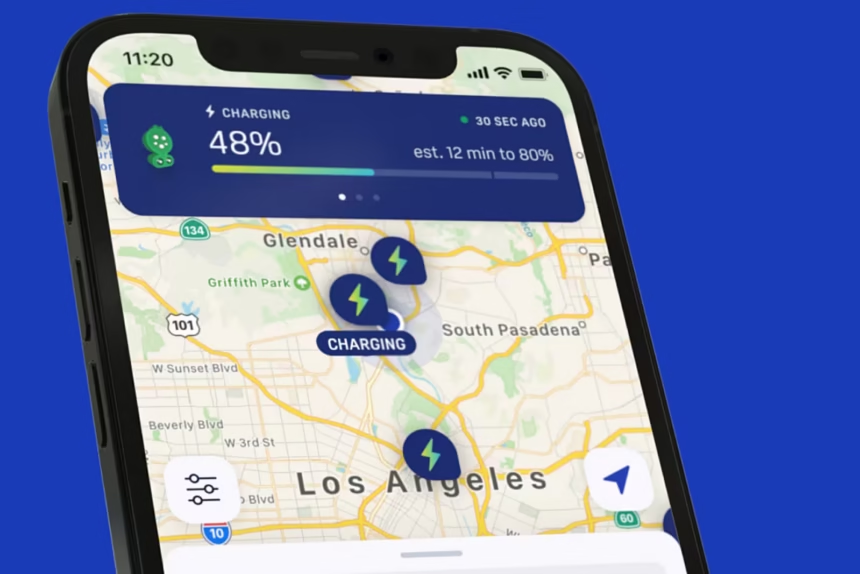
The Electrify America app now features “Power Delivery Graphs.” This allows users to see the actual charging curve their vehicle is achieving in real time. It helps drivers understand if their battery is pre-conditioned properly or if the charger is being throttled due to grid demand.
6. EVgo: Reliability at Your Fingertips
EVgo has distinguished itself through its “Autocharge+” feature, which brought “Plug and Charge” convenience to many vehicles years before it became a standard. In 2026, EVgo’s app is particularly strong in urban areas, partnering with retail giants like Whole Foods and Lowe’s to provide convenient charging during errands.
The app also features a robust rewards program. Users earn points for every charging session, which can be redeemed for charging credits or discounts at partner retailers. For the budget-conscious driver, these rewards can significantly reduce the annual cost of vehicle operation.
7. Octopus Electroverse: The All-in-One Aggregator Solution
The biggest frustration for EV drivers has historically been the need for a dozen different apps and RFID cards. Octopus Electroverse has solved this by creating a massive roaming network. With one app and one “Electrocard,” you can access hundreds of different networks across Europe and North America.
In 2026, Electroverse has introduced “Interactive Billing.” Instead of receiving a dozen different receipts, all your charging costs are consolidated into one monthly statement. For those who also use Octopus Energy at home, these costs can even be added to their home utility bill for ultimate simplicity.
8. Zap-Map: The Essential Companion for UK and European Travel
Zap-Map continues to dominate the European market, particularly in the United Kingdom. Its 2026 update includes “Route-Side Assistance,” a feature that connects drivers with mobile repair services if they encounter a hardware fault.
Zap-Map’s “Price Monitor” is another vital tool this year. It tracks the fluctuating costs of electricity across different networks, allowing users to find the cheapest “off-peak” charging windows. This is especially useful in regions with high energy price volatility.
9. Shell Recharge: Leveraging the Global Fueling Footprint
Shell has successfully pivoted from a traditional oil company to a major player in the electric space. The Shell Recharge app provides access to a vast network of chargers located at existing petrol stations. This is a significant advantage, as these locations already have the amenities drivers need, such as restrooms, food, and well-lit areas.
In 2026, the app integrates with Shell’s loyalty program, allowing users to use fuel points toward electric charging. The app also features “Hybrid Routing,” which is useful for drivers of Plug-in Hybrid Electric Vehicles (PHEVs) who may still need to find traditional fuel occasionally.
10. Enphase: Leading the Bidirectional Charging Frontier
Enphase is a newcomer to the top 10 list but has earned its spot due to the explosion of bidirectional charging in 2026. Their app manages the Enphase IQ Bidirectional Charger, which allows your vehicle to power your home during an outage or sell energy back to the grid during peak hours.
The Enphase app is less about finding a public charger and more about managing your vehicle as a “battery on wheels.” It uses AI to determine when to charge your car using your home’s solar panels and when to discharge that energy to save money on your home electricity bill. This is the future of sustainable living.
Advanced Features to Look for in 2026
As we move deeper into the decade, the feature set of these applications is becoming increasingly sophisticated. When choosing your primary apps, look for these advanced capabilities that are becoming standard in 2026.
Predictive AI and Port Availability
There is nothing more frustrating than arriving at a charger only to find it occupied or broken. Top-tier apps now use historical data and real-time telemetry to predict occupancy. For instance, an app might tell you that a station is currently 80 percent likely to have an open stall when you arrive in twenty minutes based on current traffic patterns and charging trends.
Vehicle-to-Grid (V2G) and Passive Income
The most exciting development in 2026 is the ability to make money while your car is parked. V2G-enabled apps allow your car to participate in “demand response” programs. When the grid is under stress, the utility company can “borrow” a small amount of energy from your car’s battery. In exchange, you receive credits or direct payments. For high-mileage drivers or fleet operators, this can generate hundreds of dollars in passive income annually.
Navigating the Financial Landscape: Subscriptions and Tax Credits
Charging costs in 2026 are more complex than simply paying per kilowatt-hour. Most major networks now offer subscription models that function like a gym membership. For a flat monthly fee, you get access to discounted rates.
Furthermore, these apps are now integrating with government databases to help users claim tax credits. In many jurisdictions, the cost of installing a home charger or the electricity used for charging can be partially offset by environmental incentives. The best apps track your charging history and generate the necessary documentation for your tax filings.
Hardware Compatibility: The NACS Transition of 2026
The industry-wide move to the NACS (SAE J3400) standard has simplified hardware but complicated the software transition for older vehicles. If you drive a pre-2025 EV that uses the CCS or CHAdeMO standard, you will need apps that can specifically filter for stations with the correct adapters.
Most 2026 apps now include an “Adapter Manager” section where you can save the specific hardware you carry in your trunk. The app will then only show you stations that are compatible with your specific setup, preventing a wasted trip to a charger you cannot use.
Troubleshooting and App Security
With the increase in digital transactions, security has become paramount. EV charging apps in 2026 utilize blockchain technology for secure, anonymous payments and multi-factor authentication to protect your account.
If you encounter an issue at a station, look for apps that offer “Live Remote Diagnostics.” In many cases, the app can send a signal to the charging station to reboot the hardware, fixing the problem without the need for a technician to visit the site. This has improved the industry-wide “uptime” metric to over 98 percent this year.
The Future of Autonomous Charging and Robotics
As we look toward the end of 2026 and into 2027, the first autonomous charging stations are beginning to appear in select urban centers. These stations use robotic arms to plug into the vehicle without the driver ever leaving their seat.
Apps like Tesla and EVgo are already testing interfaces for this technology. In the future, your car will be able to drive itself to a charger in the middle of the night, handle the transaction via the app, and return to your driveway fully charged by morning.
Live Daily Information and Real-Time Tracking
To ensure you have the most current information, it is essential to use platforms that provide live data feeds. Below are the authoritative sources for real-time charging status and infrastructure updates as of late 2025 and into 2026:
- PlugShare Live Map: The most accurate community-driven map for global station status. https://www.plugshare.com
- Department of Energy (DOE) Alternative Fuel Data Center: The official US government source for infrastructure development and tax credit information. https://afdc.energy.gov
- National Renewable Energy Laboratory (NREL) Charging Analysis: Deep dives into charging trends and grid impact. https://www.nrel.gov
- Tesla Supercharger Tracker: Real-time updates on new Supercharger openings and NACS compatibility. https://www.tesla.com/findus
- Zap-Map Live Status: The primary source for UK and European charging uptime and pricing. https://www.zap-map.com
Conclusion
The electric vehicle revolution is no longer a promise of the future; it is the reality of the present. In 2026, the difference between a stressful journey and a seamless one often comes down to the software in your pocket. By leveraging the apps discussed in this guide, you can ensure that you always have access to the fastest, most reliable, and most cost-effective power available.
As technology continues to evolve, stay curious and keep your apps updated. The grid of 2026 is an intelligent, living system, and these applications are your gateway to a cleaner, more efficient way of moving through the world.