
The electric vehicle landscape in 2026 has transitioned from a niche market into a global standard for mobility. With millions of new drivers hitting the road this year, the infrastructure is under more pressure than ever before. This surge in adoption has brought about a significant shift in how we interact at public stations. EV charging etiquette in 2026 is no longer just about being polite: it is a vital social contract that ensures the efficiency of our shared energy networks. Whether you are a veteran of the early Tesla days or a new owner of a solid-state battery-powered SUV, understanding the unwritten and increasingly codified rules of the road is essential for a seamless travel experience.
- The State of Global Charging Infrastructure in 2026
- Rule 1: The 80 Percent Threshold and the Curve of Diminishing Returns
- Rule 2: Matching Vehicle Capability to Charger Output
- Rule 3: The 10-Minute Exit and the Rise of Idle Fees
- The Impact of Autonomous Charging Robots and AI
- Vehicle-to-Grid (V2G) Etiquette: Sharing with the Community
- Reporting and Maintenance: The “Pay It Forward” Principle
- Managing the “ICEing” Conflict
- The Cultural Shift in Workplace Charging
- Navigating Legal and Insurance Nuances
- Source Links and References for 2026 Trends
- Summary of the 2026 EV Etiquette Code
- The Future: Toward Wireless and Beyond
The State of Global Charging Infrastructure in 2026
As of early 2026, the global charging network has undergone a massive technological overhaul. In Europe, the Alternative Fuels Infrastructure Regulation (AFIR) has fully kicked in, mandating that all new fast chargers support contactless bank card payments and provide transparent, real-time pricing. In the United States, the National Electric Vehicle Infrastructure (NEVI) program has accelerated its deployment, with thousands of new ultra-fast stations opening along designated alternative fuel corridors.
These advancements mean that chargers are more reliable than they were just two years ago, but they are also busier. The sheer volume of traffic means that a single person staying too long can trigger a ripple effect of delays for dozens of other travelers. This is why 2026 has been dubbed the year of the mindful charger.
Rule 1: The 80 Percent Threshold and the Curve of Diminishing Returns
The most critical piece of etiquette in 2026 remains the 80 percent rule. Most modern lithium-ion and even the first generation of mass-market solid-state batteries charge at their peak speed until they reach approximately 80 percent capacity. Beyond this point, the charging speed drops significantly to protect the battery chemistry.
In a crowded station, staying to reach 100 percent is often considered a breach of etiquette. If your car takes 15 minutes to go from 10 percent to 80 percent but another 45 minutes to reach 100 percent, you are effectively occupying a high-speed stall while drawing power at a snail’s pace. Unless you absolutely require that extra range to reach a remote destination, the standard protocol is to unplug at 80 percent and free up the stall for the next driver.
Rule 2: Matching Vehicle Capability to Charger Output
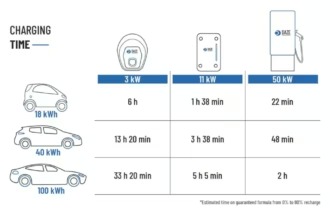
One of the biggest frustrations in 2026 is seeing a vehicle with a maximum intake of 50 kW plugged into a 350 kW ultra-fast charger. High-power chargers are designed for vehicles with advanced 800V architectures that can handle massive energy flows.
If you are driving a model that cannot utilize those high speeds, you should prioritize Level 2 or lower power DC chargers. By occupying a 350 kW stall, you are preventing a compatible vehicle from utilizing its full potential, which slows down the entire queue. Checking your vehicle’s peak charging rate in the owner’s manual or on your dashboard is a prerequisite for being a responsible member of the EV community.
Rule 3: The 10-Minute Exit and the Rise of Idle Fees
In 2026, many major networks like Electrify America, Ionity, and Tesla have implemented aggressive idle fees to combat stall hogging. These fees often start at 1.00 dollar per minute and can escalate the longer you stay.
The etiquette standard is now the 10-minute grace period. Once your charging session is complete, you are expected to move your vehicle within ten minutes. Modern apps provide real-time notifications when your car is nearly done, so there is no excuse for being unaware of your status. Treat a charging stall like a gas pump: you would never leave your car at the pump while you go inside for a 40-minute sit-down meal, and the same applies to EV charging.
The Impact of Autonomous Charging Robots and AI
A major development this year is the deployment of Automatic Charging Robots (ACR). Companies like Hyundai and various European tech firms have started installing these robotic arms in high-density urban areas and premium charging hubs.
These robots communicate directly with the vehicle to open the charge port and plug in without human intervention. This has changed etiquette in two ways. First, it requires drivers to park with precision so the sensors can align. Second, it has introduced a new social rule regarding robot priority. If a robot is currently servicing a line of vehicles in an automated parking garage, trying to manually “skip” the robot by plugging in yourself can disrupt the system’s logic and cause technical delays for everyone.
Vehicle-to-Grid (V2G) Etiquette: Sharing with the Community
2026 has seen the mainstream adoption of V2G technology. Many drivers now use their cars as mobile batteries to support the electrical grid during peak hours. This has introduced a complex new layer to charging etiquette.
When you are plugged into a V2G-enabled station, the grid may actually pull power from your car to prevent a local blackout. The etiquette here involves transparency. If you are participating in a V2G program, ensure your settings are configured to leave you with enough “get home” range. It is also considered good form to avoid high-demand V2G discharge if you know you will need a rapid refill immediately after, as this puts double the strain on the station’s cooling systems.
Reporting and Maintenance: The “Pay It Forward” Principle
With the expansion of the network, maintenance remains a challenge. The 2026 etiquette guide strongly emphasizes the role of the user in station upkeep. If you encounter a broken screen, a frayed cable, or a software glitch, do not just drive away. Use the network’s app or a community platform like PlugShare to report the issue immediately.
Providing a quick update on a charger’s status helps the next driver avoid arriving with 2 percent battery only to find a nonfunctional unit. In 2026, “ghosting” a broken charger is seen as a sign of a poor community member.
Managing the “ICEing” Conflict
The term “ICEing” refers to when an Internal Combustion Engine vehicle parks in an EV stall. While this is increasingly illegal in many jurisdictions, it still happens. The 2026 protocol for dealing with this has shifted from confrontation to documentation.
Instead of engaging in a heated argument with an ICE driver, the recommended step is to report the incident to the site operator or through local city apps that handle parking enforcement. Many charging stations now come equipped with 360-degree cameras that automatically flag non-EV occupants, but user reports remain a vital backup.
The Cultural Shift in Workplace Charging
For many professionals, 2026 is the year when workplace charging became a standard perk. However, with more employees driving EVs, the competition for office chargers is fierce.
The standard office etiquette is the “Half Day Switch.” If you arrive at 8:00 AM, you charge until noon and then move your car to a non-charging spot during your lunch break to allow a colleague to use the stall in the afternoon. Many companies have now integrated their Outlook or Google Calendars with their charging stations to automate this scheduling. Ignoring these reservations is now seen as a major professional faux pas.
Navigating Legal and Insurance Nuances
In 2026, the legal framework surrounding charging has tightened. Unplugging someone else’s car, even if they have finished charging, can now be classified as tampering with private property in certain states. If the act of unplugging causes a surge or damages the locking mechanism of the port, you could be held liable for expensive repairs.
Insurance companies have also started to include “charging station liability” in their policies. If you trip over a cable because you didn’t wrap it up properly, or if your vehicle causes a fire at a station due to an unauthorized modification, you may find your claims denied if you were not following standard safety protocols. Etiquette and safety are now legally intertwined.
Source Links and References for 2026 Trends
- European Commission: AFIR Regulation Standards 2026
- U.S. Department of Transportation: NEVI Program Updates
- ISO 15118: Road Vehicles—Communication Interface for Plug & Charge
- Zapmap: UK Charging Statistics and Growth 2025-2026
- Hyundai Robotics: Autonomous Charging Robot (ACR) Development
Summary of the 2026 EV Etiquette Code
| Rule | Action | Why it Matters |
| The 80% Rule | Unplug at 80% capacity in busy hubs. | Prevents long wait times during the slow trickle phase. |
| The Speed Match | Use chargers that match your car’s kW limit. | Keeps ultra-fast stalls open for high-performance EVs. |
| The 10-Minute Rule | Move your vehicle immediately after charging ends. | Avoids idle fees and clears space for others. |
| Report Faults | Log broken chargers in apps like PlugShare. | Helps the community plan and forces repairs. |
| Cable Management | Always hang the cable back on the holster. | Prevents tripping hazards and cable damage. |
The Future: Toward Wireless and Beyond
As we look toward 2027 and 2028, the etiquette may shift again with the rise of wireless inductive charging pads embedded in parking spots. For now, the physical cable remains our primary link to energy. By following these rules of etiquette in 2026, you contribute to a smoother, faster, and more respectful transition to a fully electrified world. The technology has arrived, and now it is up to the drivers to ensure that the culture of the road keeps pace with the speed of the electrons.