
The transition to sustainable transportation has reached a definitive tipping point as we move through 2026. While the previous decade focused on the proliferation of lithium-ion batteries and the expansion of plug-in networks, the current era is defined by the “Invisible Revolution.” This refers to the massive deployment of wireless electric vehicle (EV) charging systems that eliminate the need for physical cables, transforming how we interact with our cars, fleets, and city infrastructure. In this comprehensive guide, we explore the technology, the market leaders, and the economic landscape that makes wireless power transfer the backbone of modern transit.
- The Invisible Revolution: Why Cables are Becoming Obsolete
- The Core Technology: How Wireless EV Charging Works in 2026
- Static vs. Dynamic Charging: The Rise of Electric Roads
- The Economic Impact: Charging-as-a-Service (CaaS) and ROI
- Key Players Leading the 2026 Market
- Vehicle-to-Grid (V2G) and Grid Stability
- Overcoming the Challenges: Efficiency and Safety
- Global Market Projections and Adoption Rates
- Case Study: The “Smart City” Implementation in 2026
- The Road Ahead: What to Expect Post-2026
- Conclusion: A Seamless Future
The Invisible Revolution: Why Cables are Becoming Obsolete
For years, the primary friction point for potential electric vehicle owners was “range anxiety.” However, as we have seen in 2025 and early 2026, that concern has shifted to “charging friction.” Plucking a heavy, often dirty cable from a pedestal and manually connecting it to a vehicle is a remnant of the internal combustion era’s refueling habits. Wireless charging, technically known as Wireless Power Transfer (WPT), offers a seamless alternative that aligns with the broader move toward automation.
The convenience factor is the most immediate benefit. Imagine pulling into your garage or a public parking spot and having the charging process begin automatically without pressing a single button. For the average consumer, this is a luxury. For autonomous fleet operators, it is a necessity. A self-driving “Robotaxi” cannot plug itself in, making wireless pads the only logical solution for a truly human-free transportation network.
The Core Technology: How Wireless EV Charging Works in 2026
At the heart of this technology are two primary methods: Inductive Charging and Magnetic Resonant Induction. While the basic principles have been understood for over a century, the engineering breakthroughs realized in 2024 and 2025 have pushed efficiency rates to over 93 percent, matching or even exceeding some traditional wired Level 2 chargers.
Magnetic Resonant Induction
Most modern systems, including those led by industry pioneer WiTricity, utilize magnetic resonance. Unlike basic induction (which you might use for a smartphone), resonant induction allows for a greater “air gap” between the ground pad and the vehicle’s receiver. In 2026, this gap typically ranges from 10 to 25 centimeters, allowing for varying vehicle heights from low-slung sports cars to high-clearance SUVs.
The system consists of two main components:
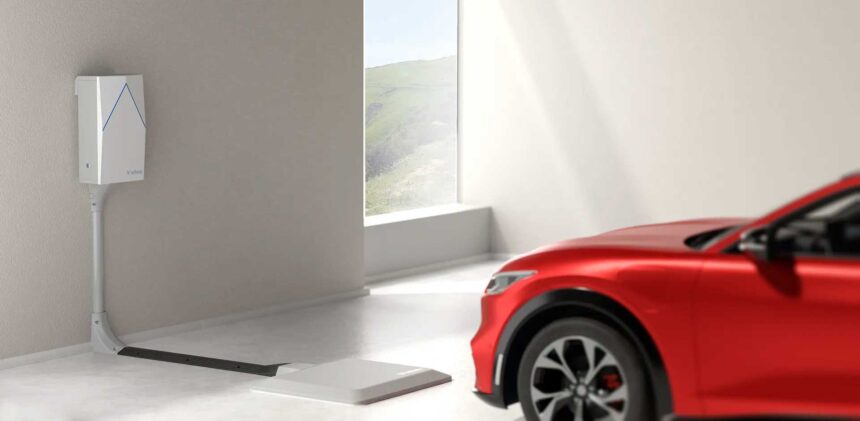
- The Ground Assembly (GA): A flat pad embedded in or placed on the pavement, connected to the power grid.
- The Vehicle Assembly (VA): A lightweight receiver coil mounted on the undercarriage of the EV.
When the vehicle is positioned over the pad, the GA creates an oscillating magnetic field. The VA is tuned to the exact same frequency, allowing it to “capture” the energy and convert it back into DC electricity to charge the battery.
The SAE J2954 Standard: Global Interoperability
One of the most critical milestones for the industry was the finalization and widespread adoption of the SAE J2954 standard. In 2026, this standard ensures that a Tesla can charge on a BMW pad, and a Ford commercial van can utilize a public charging station in London or Tokyo without compatibility issues.
The standard defines three power levels for light-duty vehicles:
- WPT1: 3.7 kW (Home/Overnight charging)
- WPT2: 7.7 kW (Standard residential/Workplace charging)
- WPT3: 11 kW (Fast wireless charging for public and commercial use)
Furthermore, the recent introduction of SAE J2954/2 has brought wireless charging to the heavy-duty sector, supporting power levels up to 500 kW for buses and long-haul trucks.
Static vs. Dynamic Charging: The Rise of Electric Roads
As of 2026, the industry is bifurcated into two distinct categories: Static and Dynamic. Both are essential for a complete ecosystem, but they serve very different operational needs.
Static Wireless Charging
This is the most common form of the technology, found in residential garages, hotel parking lots, and fleet depots. The vehicle remains stationary over a pad. By 2026, we are seeing Automated Valet Parking (AVP) integrated with static pads. A driver can hop out at the entrance of a shopping mall, and the car will navigate itself to a wireless charging spot, align perfectly using the Differential Inductive Positioning System (DIPS), and begin replenishing its battery.
Dynamic Wireless Power Transfer (DWPT)
Perhaps the most exciting development in 2026 is the commercialization of “Electric Roads.” Dynamic Wireless Power Transfer allows vehicles to charge while they are in motion. By embedding induction coils under the asphalt of major highways and urban bus routes, cities are effectively turning the road itself into a giant charger.
Significant projects in 2025 and 2026 have proven the viability of this tech:
- Detroit, Michigan: The first public wireless charging road in the United States is now a high-traffic corridor for commercial deliveries.
- The A10 Motorway, France: A massive consortium led by VINCI Autoroutes and Electreon has successfully deployed a system that allows heavy-duty trucks to maintain their state of charge while cruising at 90 km/h.
- Tel Aviv, Israel: The city’s bus network now relies on dynamic charging to reduce the size of the batteries needed on board, making the vehicles lighter and more efficient.
The Economic Impact: Charging-as-a-Service (CaaS) and ROI
The shift to wireless is not just about convenience: it is a calculated financial move for businesses and municipalities. The high initial cost of infrastructure has been mitigated by the rise of Charging-as-a-Service (CaaS).
Under a CaaS model, fleet operators do not pay for the hardware or installation upfront. Instead, they pay a monthly subscription or a per-kWh fee to a provider like Electreon or InductEV. This shifts the expense from Capital Expenditure (CAPEX) to Operational Expenditure (OPEX), making it much easier for companies to justify the transition to electric.
Financial Benefits for Fleet Operators
For a logistics company operating a fleet of 500 vans, every minute a vehicle spends parked at a plug is a minute of lost revenue. Wireless charging allows for “snacking”: picking up small amounts of energy at loading docks, traffic lights, or during short pauses in the duty cycle.
- Increased Uptime: Vehicles no longer need to be taken “offline” for hours to reach a full charge.
- Battery Downsizing: With dynamic charging, vehicles can use smaller, cheaper batteries because they are replenished throughout the day. This can reduce the cost of an electric truck by up to 25 percent.
- Reduced Maintenance: No moving parts, no cables to wear out, and no risk of vandalism or copper theft, which has plagued wired stations in recent years.
Key Players Leading the 2026 Market
The competitive landscape of 2026 is dominated by a few key innovators who have successfully bridged the gap between lab prototypes and industrial-scale deployment.
1. WiTricity
As the primary patent holder for magnetic resonance technology, WiTricity has become the “Intel” of the wireless charging world. They license their technology to automotive Tier-1 suppliers and OEMs. Their WiTricity Halo system is now a factory option for several luxury and mid-range EV models launched in late 2025.
2. Electreon
The undisputed leader in dynamic charging, Electreon focuses on the infrastructure side. They have partnered with governments across Europe and North America to build electric road systems. Their success in 2026 is largely due to their “invisible” installation process, which places coils under the road without requiring a complete reconstruction of the highway.
3. InductEV (formerly Momentum Dynamics)
Focusing on high-power stationary charging, InductEV has cornered the market for electric buses and heavy-duty drayage trucks at ports. Their 300 kW+ systems allow a transit bus to charge in minutes while passengers are boarding, ensuring 24/7 operation without a massive battery pack.
4. Tesla and the Wireless Pad Integration
In a move that shook the industry in 2025, Tesla officially released its proprietary wireless home charging pad. While they continue to support their Supercharger network for long-distance travel, the integration of a wireless pad for the Model Y and the new Robotaxi fleet signals a major shift toward automated, hands-free residential charging.
Vehicle-to-Grid (V2G) and Grid Stability
A major advantage of wireless charging that is being realized in 2026 is its role in Grid Stabilization. Because wireless systems are increasingly bidirectional, they support Vehicle-to-Grid (V2G) technology without the hassle of plugging in.
When thousands of EVs are parked over wireless pads in a city, they act as a massive, distributed battery. During peak energy demand, the local utility can draw small amounts of power back from the vehicles to prevent blackouts. Because the connection is automatic, the “participation rate” for V2G programs is significantly higher with wireless systems than with wired ones, where owners often forget to plug in.
Overcoming the Challenges: Efficiency and Safety
Critics of wireless charging often point to energy loss and safety concerns regarding electromagnetic fields (EMF). However, the data from 2026 tells a different story.
Efficiency Comparison
While a wired charger has a theoretical efficiency of 95 to 98 percent, the real-world efficiency often drops due to heat loss in the cables and connectors. Wireless systems in 2026 consistently hit 90 to 93 percent efficiency. For most users, the 3 to 5 percent difference is a negligible price to pay for the massive increase in convenience and the reduction in mechanical wear.
Safety and EMF Standards
Modern wireless chargers operate at 85 kHz, a frequency specifically chosen to minimize interference. The systems are equipped with Foreign Object Detection (FOD) and Living Object Detection (LOD). If a cat walks under a charging car or a metal coin falls onto the pad, the system instantly shuts down to prevent heat buildup or injury. In 2026, these systems are regulated by strict international standards, making them as safe as a household microwave or a Wi-Fi router.
Global Market Projections and Adoption Rates
The financial outlook for the wireless EV charging sector is incredibly bullish. Analysts at firms like SkyQuest and Global Market Insights have updated their 2026 forecasts to reflect the faster-than-expected adoption:
- Market Size: The global wireless EV charging market is projected to reach $18.5 billion by the end of 2026.
- Growth Rate: A staggering Compound Annual Growth Rate (CAGR) of over 35 percent between 2024 and 2030.
- Regional Leaders: While North America leads in private residential adoption, Europe and the Asia-Pacific region are the leaders in public infrastructure and dynamic electric roads.
Case Study: The “Smart City” Implementation in 2026
To understand the practical application of this technology, we can look at the “Smart District” in Stockholm, Sweden. By early 2026, the district completed a total integration of wireless power:
- Public Transit: All city buses are equipped with InductEV receivers, charging at every fifth stop.
- Delivery Fleets: Logistics hubs for companies like DHL and Amazon utilize dynamic strips at entry and exit gates to top off delivery vans.
- Public Parking: Street-side parking spots have been retrofitted with 11 kW WiTricity pads, billed through a unified city app.
This integrated approach has reduced the city’s need for massive “charging hubs,” which often caused localized grid strain, and instead spread the energy demand more evenly across the urban environment.
The Road Ahead: What to Expect Post-2026
As we look toward the end of the decade, the evolution of wireless charging will likely move toward Solid-State Battery optimization. Solid-state batteries, which are beginning to enter the market in 2026, can handle much higher charging speeds with less heat. This will allow wireless pads to move from 11 kW to 22 kW or even 50 kW for passenger cars, effectively matching the speed of current DC fast chargers.
Furthermore, we expect to see “Wireless Corridors” connecting major cities. A drive from New York to Washington D.C. could eventually be done without a single stop, as the car draws power from the road itself, maintaining a constant 80 percent charge for the entire journey.
Conclusion: A Seamless Future
Wireless EV charging in 2026 is no longer a “future tech.” It is a proven, standardized, and economically viable solution to the challenges of modern mobility. By removing the cord, we have removed the final barrier to mass EV adoption. Whether it is a static pad in a suburban garage or a dynamic highway in the heart of Europe, the ability to transfer power through the air is rewriting the rules of the road.
As infrastructure continues to expand and more manufacturers make wireless receivers a standard feature, the sight of a charging cable will soon become as rare as a hand-crank for a car engine. The future is electric, but more importantly, the future is invisible.
Sources and Further Reading
- Driivz: 2026 EV Charging Industry Predictions and Trends
- Electreon: Wireless Electric Road Projects and Dynamic Charging Data
- SAE International: J2954 Wireless Power Transfer Standard Technical Specifications
- SkyQuest Technology: Wireless EV Charging Market Size and Forecast 2026-2033
- WiTricity: Magnetic Resonance Technology for Automotive Applications
- InductEV: High-Power Wireless Charging for Commercial Fleets